
PPCP (Polypropylene Copolymer) is a high-performance thermoplastic material widely used in industries that require strength, toughness, and durability. At Swami Polymers, we supply premium-grade PPCP materials to support manufacturing sectors such as automotive, household products, appliance parts, industrial components, and more.
Compared to normal PP (Polypropylene Homopolymer), PPCP offers better impact resistance, improved flexibility, and higher crack resistance, especially in low-temperature environments. This makes it one of the most reliable materials for long-lasting applications.
What Is PPCP (Polypropylene Copolymer)?
PPCP is produced by combining propylene monomers with ethylene monomers, resulting in a stronger and more impact-resistant polymer structure. Due to the added ethylene content, PPCP becomes tougher and more flexible than standard PP.
Key Characteristics of PPCP
- Excellent impact strength (better than PP)
- High chemical resistance
- Good low-temperature performance
- High durability and stress-crack resistance
- Can be easily injection-molded
- Lightweight but strong
- Recyclable material
Because of these properties, PPCP is heavily used in industries requiring rigid yet tough parts.
How PPCP Is Manufactured
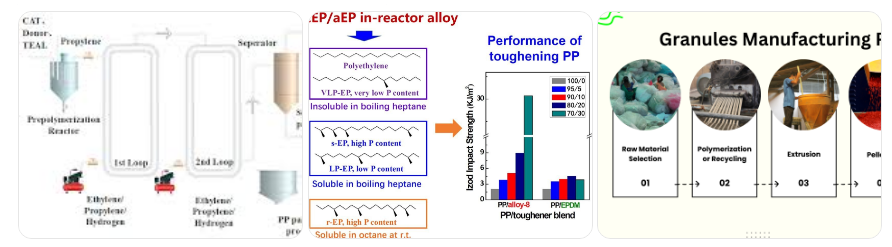
The production of PPCP involves creating a copolymer through controlled polymerization.
1. Raw Material Preparation
- Propylene gas and ethylene gas are purified.
- They are carefully measured, as the ratio affects strength, flexibility, and melting point.
2. Copolymerization Process
During polymerization:
- Propylene and ethylene are combined inside a reactor.
- A catalyst (usually Ziegler–Natta) initiates the reaction.
- Polymer chains form with embedded ethylene units, providing enhanced toughness.
This carefully controlled process creates impact-copolymer PP, known commercially as PPCP.
3. Processing Into Granules
Once polymerization is complete:
- The copolymer is extracted
- Stabilized
- Dried
- Cut into PPCP granules
Manufacturers then use these granules for injection molding or extrusion to create high-strength components.
Types of PPCP
1. Impact Copolymer PPCP
- Highest toughness
- Best for automotive and industrial applications
2. Random Copolymer (RCP) – Related Variant
Although not the same as PPCP, RCP is a softer, clearer copolymer used in packaging and household items.
Applications of PPCP
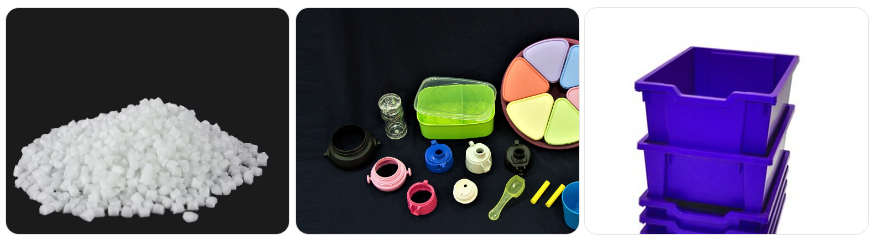
PPCP is used across multiple sectors due to its superior strength and durability. At Swami Polymers, our PPCP materials are chosen for:
Automotive Industry
- Battery cases
- Bumpers
- Air ducts
- Dashboards
- Trims & panels
Industrial Applications
- Storage crates
- Pallets
- Tool housings
- Machine components
- Chemical containers
Household & Consumer Products
- Buckets
- Furniture parts
- Containers
- Home appliance components
Electrical & Electronic
- Junction boxes
- Switch housings
- Cable management parts
Why Industries Prefer PPCP (And Why Swami Polymers Supplies It)
At Swami Polymers, PPCP is one of our most recommended materials because:
It delivers superior toughness compared to standard PP
It withstands heavy loads and impact
It performs well in low-temperature environments
It is cost-effective for mass production
It offers excellent chemical resistance
It supports consistent quality in molded products
We supply PPCP in various grades depending on the customer’s manufacturing needs.